

High-volume commercial manufacturers select fully automated systems to maximize throughput, minimize labor costs, and maintain batch consistency. Small enterprises and craft producers prefer a semi-automated Gummy Bear Production Line to lower upfront capital expenditure and gain recipe flexibility. Target output and available capital dictate the ideal setup.
| Metric | Value |
|---|---|
| 2024 Market Size | USD 5,453.6 Million |
| 2025 Market Size | USD 6,427.62 Million |
| 2034 Projected Market Size | USD 28,206.4 Million |
| Projected CAGR (2025–2034) | 4.2% |
Tip: Rapid global market growth highlights the importance of selecting scalable machinery early.
Comparing Gummy Bear Production Line Efficiency
Production line efficiency determines operational throughput, overall daily profitability, and labor expenditure. Manufacturers evaluate speed, workforce distribution, and product accuracy to select the correct machinery setup.
Speed and Output Capacities
Automation levels directly dictate overall production speed and hourly output volume. Fully automated configurations maintain continuous operation without frequent manual stops or batch delays.
- Fully Automated Systems: Continuous cooking units boil syrup and pump raw mass straight into precision depositors. Integrated cooling tunnels instantly set the gummies, driving output rates above 500 kg/h to 1000 kg/h.
- Semi-Automated Systems: Operators manually transport cooked syrup kettles to semi-automatic depositing heads. Output generally caps around 50 kg/h to 150 kg/h due to manual transit delays.
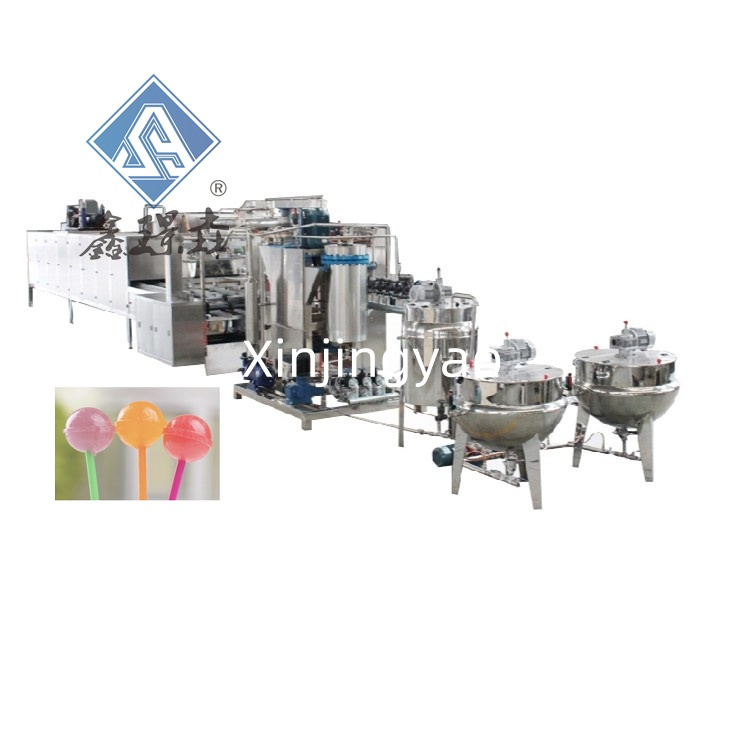
Note: Integrated machinery, such as the Shanghai Jingyao Soft Candy and Hard Candy Production Line, seamlessly connects syrup boiling, candy molding, and final packaging into one continuous stream to eliminate production bottlenecks.
Labor Requirements and Workflow
Labor demands vary significantly based on equipment automation and layout design. Automated systems shift worker responsibilities from manual lifting to supervisory monitoring and quality checks.
| Production Line Type | Number of Operators Required | Key Operational Tasks |
|---|---|---|
| Semi-Automated Line | 2 – 3 operators | Manual handling and partial line supervision |
| Fully Automated Line | 3 – 5 operators (for 2 daily batches) | Cooking, conveying, coating, system monitoring, and equipment cleaning |
Semi-automated setups require workers to lift trays, mix ingredients manually, and manage individual packaging machines. Fully automated operations utilize pneumatic transfer lines and automated oiling or sanding drums. Workers primarily oversee control panels, adjust digital parameters, and ensure raw material hoppers remain full.
Product Consistency and Scrap Rates
Batch consistency dictates product quality, brand reputation, and profit margins. Variations in piece weight, shape deformities, or improper gelatin setting create product scrap and waste.
- Weight Precision: Servo-driven depositor nozzles inject exact liquid volumes into starch or silicone molds. Automated lines achieve weight tolerances within ±1%, while semi-automated nozzles produce higher variance.
- Temperature Control: Digital sensors regulate cooking and holding temperatures continuously. Automated temperature feedback loops prevent syrup scorching and gelatin degradation.
- Scrap Reduction: Consistent demolding mechanisms prevent torn or misshapen candy pieces. Automated lines keep scrap rates below 1%, whereas manual tray handling in semi-automated lines increases structural damage to soft gummies.
Investing in an advanced Gummy Bear Production Line ensures precise ingredient dosing, uniform gummy texture, and minimal material waste across every batch.
Financial Analysis for Gummy Bear Production Line Investment
Selecting candy machinery requires a clear financial evaluation. Feasibility studies analyze essential performance benchmarks to guide purchasing decisions:
- Profit Margins: Healthy confectionery businesses achieve gross profit margins between 30% and 40%, alongside net profit margins ranging from 15% to 25%.
- Capital Investment Distribution: Equipment purchasing represents the single largest expenditure segment within total initial Capital Expenditure (CapEx).
- Key Investment Metrics: Decision-makers evaluate primary metrics including Return on Investment (ROI), Net Present Value (NPV), Payback Period, Capital Expenditure (CapEx), Operating Expenditure (OpEx), Liquidity, Profitability, and Sensitivity Analysis.
Upfront Capital Expenditure
The initial investment for a modern Gummy Bear Production Line depends on system capacity, automation levels, and integration capabilities. Machinery buyers choose between individual units or complete turnkey plants based on target output goals.
| Machinery Type | Description / Features | Estimated Price Range |
|---|---|---|
| Complete Gummy Production Lines | Turnkey setups combining cooking, depositing, molding, cooling, and packing | $50,000 – $150,000 |
| Commercial Units | Standard mid-scale commercial production equipment | $40,000 – $60,000 |
| Fully Automatic Systems | High-efficiency automated setups with variable capacities | $30,000 – $100,000+ |
Semi-automated packaging lines require lower upfront machinery payments between $1,500 and $6,000. Fully automated packaging systems demand higher initial investments ranging from $8,000 to $20,000. However, fully integrated machinery like the Shanghai Jingyao Soft Candy and Hard Candy Production Line consolidates multiple processing steps into one continuous workflow, reducing the need for separate auxiliary devices.
Ongoing Operational Expenses
Operational Expenditure (OpEx) includes direct labor costs, maintenance routines, utility consumption, and component replacements. Fully automated machinery drastically reduces direct labor costs while increasing minor technical upkeep budgets.
| Cost & Maintenance Category | Automated Gummy Line | Semi-Automated Gummy Line |
|---|---|---|
| Yearly Maintenance Budget | $4,000 – $8,000 | $1,500 – $3,000 |
| Cleaning & Servicing Complexity | High (demands specialized technical knowledge) | Low (straightforward to clean and service) |
| Spare Parts Expenditure | $2,000 – $5,000 (required roughly every 5 years) | $1,000 – $2,500 (required roughly every 3 years) |
| Maintenance Frequency Drivers | Built with heavy-duty stainless steel and PLC systems, ensuring 10–15 years lifespan | Less complex construction but requires more frequent part replacements due to manual handling |
Note: Automated systems require specialized technical knowledge for cleaning and servicing, yet heavy-duty stainless steel construction extends operational equipment lifespans to 15 years.
Cost Per Unit and ROI Payback
Production volume directly affects individual unit costs and total investment recovery timelines. High-volume automated facilities lower wage expenses per kilogram of finished candy.
| Total Cost of Ownership (TCO) Factor | Fully Automated Packaging Line | Semi-Automated Packaging Line |
|---|---|---|
| Upfront Equipment Cost | $8,000 – $20,000 | $1,500 – $6,000 |
| Yearly Maintenance Expense | $1,000 – $2,500 | $600 – $1,200 |
| Annual Labor Expenditure | $12,000 – $18,000 | $20,000 – $28,000 |
| Equipment Lifespan (Replacement) | 8 to 15 years | 5 to 10 years |
| Projected 5-Year Cumulative Cost | $30,000 – $45,000 | $22,000 – $38,000 |
Semi-automated setups offer low entry barriers for startups. However, long-term operational expenses accumulate quickly over time due to higher ongoing labor requirements ($20,000 to $28,000 annually). Fully automated lines mitigate cumulative costs through lower labor needs ($12,000 to $18,000 annually) and minimal material waste. Commercial manufacturers achieve faster ROI payback periods on fully automated equipment by maximizing hourly output and reducing scrap rates across long production runs.
Maintenance and Compliance Standards
Strict hygiene standards govern commercial candy manufacturing. Operators must sanitize equipment regularly to safeguard final product quality and consumer health.
CIP Integration and Hygiene
Automated Clean-in-Place (CIP) systems streamline sanitation in a modern Gummy Bear Production Line. CIP systems sanitize internal pipes, cooking kettles, and depositor nozzles without time-consuming manual disassembly.
| Cleaning Approach | Cleaning Time Impact | Safety & Quality Outcome |
|---|---|---|
| Manual Cleaning | Requires lengthy manual sanitation | Produces inconsistent cleaning logs and potential allergen risks |
| Automated CIP System | Reduces cleaning downtime by 42% | Completely eliminates allergen cross-contamination incidents |
Maintenance and Equipment Downtime
Proactive equipment servicing stops unexpected mechanical failures and minimizes line downtime.
| Category | Specific Requirement | Operational Focus |
|---|---|---|
| Hygienic Design | Material Compliance | Utilize food-safe SS304/SS316 stainless steel with smooth surfaces. |
| Sanitation Routine | Scheduled Servicing | Conduct routine servicing on critical dosing pumps and cooling tunnels. |
| System Calibration | Dosing Precision | Periodically align dosing hardware to maintain ingredient uniformity. |
Routine calibration protects thermal sensors, maintaining precise temperature control across gelatin and pectin boiling cycles.
Regulatory and GMP Compliance
Manual plant inspections remain prone to human error and oversight. Automated supervisory systems reduce non-compliance risks through direct digital tracking.
- Continuous Line Verification: Sensors evaluate 100% of line units continuously rather than relying on periodic manual sample checks.
- Human Error Elimination: Automated data collection delivers an 80% reduction in manual inspection checks.
- Automated Audit Logs: Software automatically records time-stamped inspection reports for seamless regulatory audits.
Continuous operational monitoring triggers immediate alerts when temperature or pressure strays from approved target values. Immediate alerts allow staff to correct minor deviations before safety risks escalate.
Scalability of the Gummy Bear Production Line
Scalability allows candy manufacturers to respond quickly to evolving consumer demands. Choosing the right machinery design ensures smooth transitions between different product shapes and output levels.
Mold and Recipe Flexibility
Production line configurations influence how quickly operators switch between different gummy bear shapes and flavor formulas. Semi-automated lines offer direct hands-on control for frequent batch changes, while fully automated setups utilize electronic presets for rapid transitions.
| Line Type | Speed & Frequency of Mold Changes | Speed & Flexibility of Recipe Formulations |
|---|---|---|
| Fully Automated | Enables rapid mold transitions for high-demand, varied outputs. | Facilitates quick syrup and recipe switches automatically. |
| Semi-Automated | Optimized for frequent, manual mold modifications in small batches. | Supports frequent, small-scale production adjustments. |
Automated dosing heads store multiple recipe profiles inside a central PLC system. Operators adjust flavor, color, and active ingredient settings with a single touch, reducing downtime during product flavor swaps.
Capacity Upgrades and Future Expansion
A modular Gummy Bear Production Line allows business owners to scale their processing operations smoothly without purchasing entirely new systems. Manufacturers analyze several critical operational factors when planning long-term equipment expansions:
- Modular Machine Design: Facilitates straightforward upgrades and system expansion, particularly in packaging stages.
- Cooking System Selection: Choosing between batch systems (ideal for small-to-medium volumes) and continuous systems (designed for large-scale operations).
- Automation Integration: Utilizing automated depositors capable of handling varying product viscosities to maintain high and consistent output speeds.
- Strategic Operational Alignment: Balancing budget constraints, targeted output goals, regulatory compliance, and long-term expansion plans.
Confectionery brands secure sustainable market growth by matching early equipment choices with long-term commercial goals.
Manufacturers select semi-automated systems for small batch flexibility or fully automated machinery for continuous high-volume output. Buyers must evaluate the total cost of ownership, technical workforce skills, and facility compliance before purchasing a Gummy Bear Production Line.
| Technical Parameter | Semi-Automated Setups | Fully Automated Setups |
|---|---|---|
| Speed vs. Flexibility | Lower throughput; flexible recipe adjustments | High output speed; rigid standardized operation |
| Cost Structure | Lower initial capital; higher long-term labor | High initial investment; lower unit labor expenses |
| Quality & Consistency | Subject to manual handling variance | Superior batch repeatability and precision |
| Maintenance | Simple upkeep using basic mechanical skills | Specialized technical upkeep and engineering support |
Tip: Consider ongoing energy, labor, and waste expenses rather than initial purchase price alone to maximize long-term profitability.
FAQ
Tip: Aligning facility capabilities with target market demand ensures optimal equipment selection and operational efficiency.
What is the main difference between fully automated and semi-automated gummy production lines?
Fully automated lines deliver continuous, high-volume output with minimal manual labor. Semi-automated lines require manual labor for tray transfer and offer lower upfront capital costs.
How long does it take to see a return on investment (ROI)?
Commercial manufacturers typically achieve complete ROI within 12 to 24 months on fully automated systems through reduced labor costs and lower material waste.
Which production line suits small businesses or startups best?
Small enterprises benefit most from semi-automated lines. These versatile systems lower initial machinery expenses while providing recipe flexibility for craft production.
Post time: Jul-29-2026


