

A cake baking production line relies on advanced automation components to deliver consistent results. These systems interact seamlessly to ensure precise measurements and optimal timing. Manufacturers using automated lines have reported output increases of up to 30% in the first year. Automation reduces human error, lowers labor costs, and improves workplace safety. Integration and control systems unify each process, allowing bakeries to focus on creativity and product quality.
Raw Material Handling in a Cake Baking Production Line
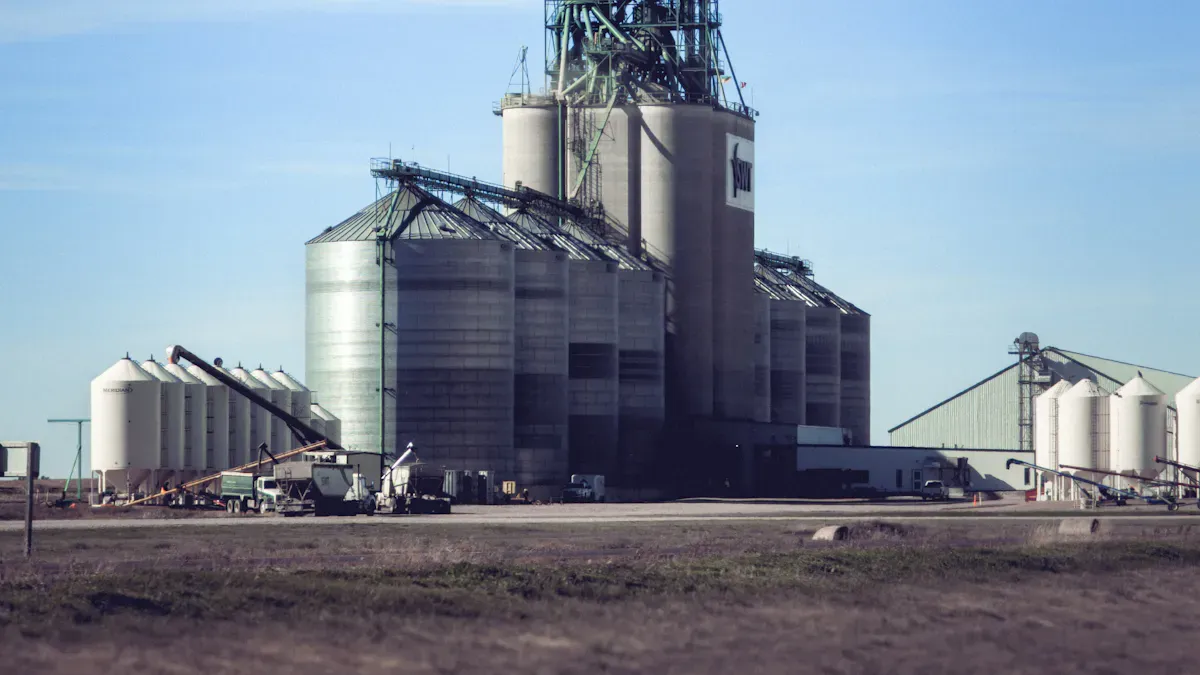
Automated Ingredient Storage and Dispensing
Automated ingredient storage and dispensing systems form the backbone of any modern cake baking production line. These systems store raw materials in enclosed, hygienic environments and dispense precise amounts when needed. By minimizing human contact, they reduce contamination risks and maintain strict hygiene standards. Operators benefit from reduced labor costs and increased production rates, as the system handles repetitive tasks efficiently. Automated dispensing ensures accuracy and repeatability, which leads to consistent product quality and less waste. Many bakeries report that these systems also improve inventory management by tracking ingredient usage in real time.
Automated ingredient storage and dispensing systems eliminate inconsistencies caused by manual measuring. This precision supports predictable outcomes and allows bakers to focus on product innovation.
Precision Weighing and Measuring Systems
Precision weighing and measuring systems guarantee that each batch receives the exact amount of every ingredient. These systems use advanced sensors and smart controls to deliver reliable results, regardless of operator skill level. Consistent measurements help maintain product quality and reduce rework costs. Automated weighing also supports large-scale production, as it can handle high volumes without sacrificing accuracy. Servo-driven motors and frequency conversion technology further enhance efficiency by optimizing energy use.
·Ensures accuracy and repeatability
·Reduces waste and rework
·Increases production speed
Conveying and Transfer Mechanisms
Conveying and transfer mechanisms move ingredients and finished products seamlessly throughout the cake baking production line. Discharge conveyors play a vital role by transferring products to downstream equipment, such as packaging stations. These systems synchronize speed and phase, preventing bottlenecks and maintaining a steady workflow. Enclosed vacuum conveying technology minimizes dust exposure and keeps the environment safe for workers. By automating the transfer process, bakeries can achieve higher throughput and maintain consistent quality from start to finish.
Mixing and Batter Preparation Automation
Automated Mixing Equipment
Automated mixing equipment forms the core of batter preparation in a cake baking production line. Large-scale bakeries rely on planetary mixers, spiral mixers, and horizontal mixers to achieve efficient and thorough blending. Planetary mixers excel at incorporating air and ensuring even distribution of ingredients, which is essential for cake batters. Spiral mixers, while popular for bread, also handle high-hydration batters with ease. Horizontal mixers support high-volume production, making them ideal for operations that prioritize speed. These machines can process 20-60 quart batches in 8-12 minutes, a significant improvement over manual mixing times. Bakeries that invest in quality mixers often see a 15-20% increase in production capacity within 12-18 months and a 40% reduction in labor costs. This efficiency allows operators to focus on maintaining quality and consistency.
Recipe Management and Control Interfaces
Recipe management and control interfaces ensure that every batch meets the same high standards. Centralized recipe storage allows operators to access and manage formulas quickly. Automated ingredient scaling adjusts recipes instantly for different batch sizes or portioning needs. Integration of sub-recipes into main recipes standardizes frequently used ingredients and processes. One-click updates to sub-recipes automatically apply changes across all linked products. These features help bakeries maintain consistency, reduce errors, and streamline production.
·Centralized recipe storage and management
·Automated ingredient scaling for batch adjustments
·Seamless integration of sub-recipes
·Instant updates across all linked products
In-Line Quality Monitoring Systems
In-line quality monitoring systems play a critical role in maintaining product standards during batter preparation. Advanced technologies such as vision inspection systems, hyperspectral imaging, and machine learning AI provide real-time analysis and feedback. These systems detect anomalies, monitor parameters like temperature and humidity, and automatically remove defective products from the line. Digital imaging tools like C-Cell evaluate baking quality using high-resolution images, analyzing over 50 parameters to ensure consistency.
| Technology Type | Description |
|---|---|
| Vision Inspection System | Ensures high standards of quality and consistency for baked goods |
| Hyperspectral Imaging | Provides real-time analysis beyond traditional measurement methods |
| Machine Learning AI | Enhances quality monitoring through anomaly detection and classification |
| Automated Rejection Mechanism | Removes defective products without manual intervention |
These technologies help bakeries deliver reliable results and maintain the reputation of their cake baking production line.
Forming, Filling, and Depositing in Cake Baking Production Lines
Automated Depositors and Molding Units
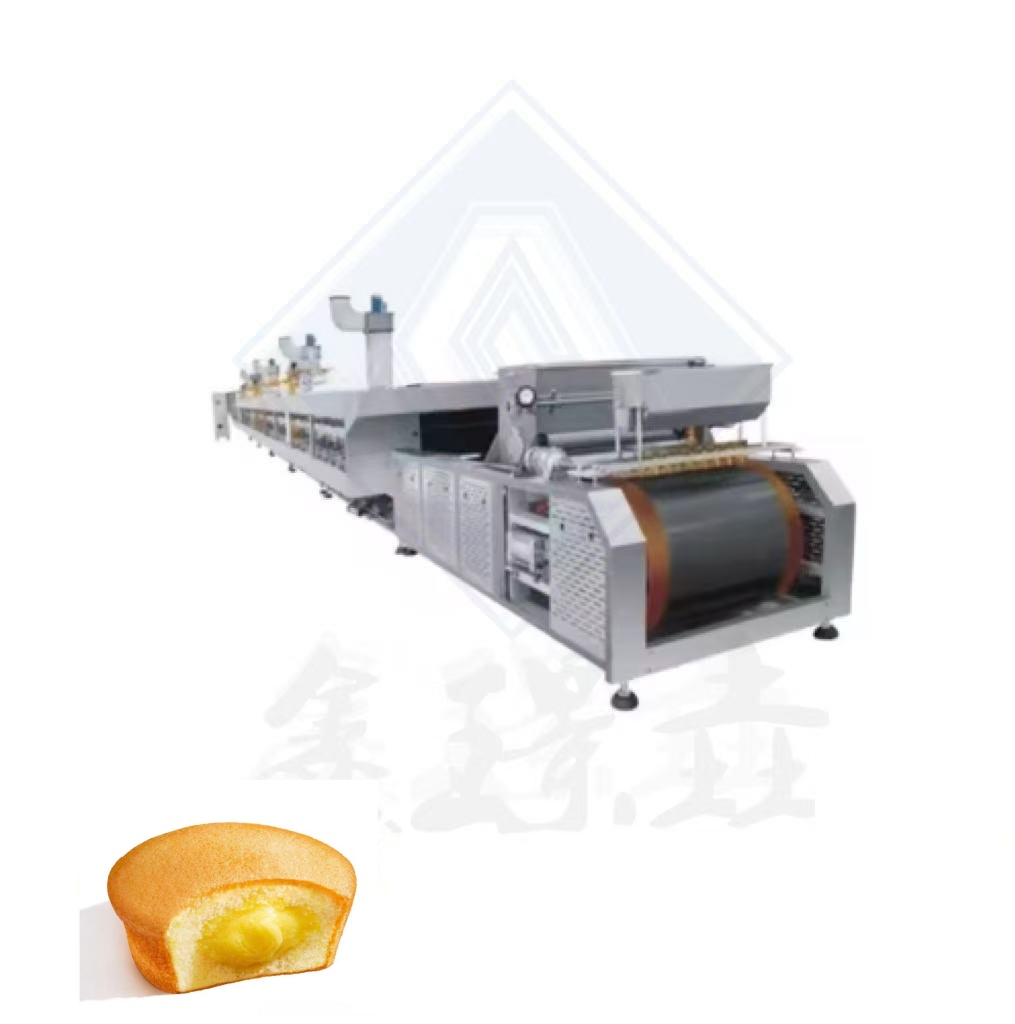
Automated depositors and molding units play a pivotal role in shaping and portioning cakes within a cake baking production line. These machines deliver high automation, enabling stable and continuous production. Operators benefit from clear 3D cake shapes and soft textures, which enhance product appeal. The equipment ensures accurate filling quantities and consistent product quality. Easy operation and maintenance simplify daily tasks, while robust construction extends machine service life.
·High automation
·Stable continuous production
·Clear 3D cake shapes
·Soft cake texture
·Accurate filling quantity
·Consistent product quality
·Easy operation and maintenance
·Long machine service life
Automated systems reduce labor costs and boost efficiency by handling batter feeding, depositing, and packaging. Precise depositing and uniform results support faster production start-up and strengthen market competitiveness.
Smart Filling Equipment with Detection Functions
Smart filling equipment uses advanced detection functions to minimize product defects. AI-powered computer vision systems enable robots to perform precise actions and make real-time decisions. These technologies detect defects accurately, ensuring only high-quality cakes move forward. The systems generate detailed 3D maps of cake surfaces, allowing dynamic adjustments for decorating and cutting. Vision inspection provides 100% product inspection, which is crucial for maintaining high standards in cake manufacturing.
Smart filling equipment ensures every cake receives the correct filling and decoration, reducing waste and improving overall quality.
Pan Handling and Portion Control
Pan handling and portion control systems automate the movement and positioning of cake pans throughout the production line. These mechanisms guarantee that each cake receives the proper portion size and shape. Automated pan handling reduces manual intervention, which improves hygiene and speeds up production. Portion control technology maintains consistency across batches, supporting reliable output and customer satisfaction. Operators can easily adjust settings to accommodate different cake types, making the process flexible and efficient.
Baking, Cooling, and Sterilization Automation
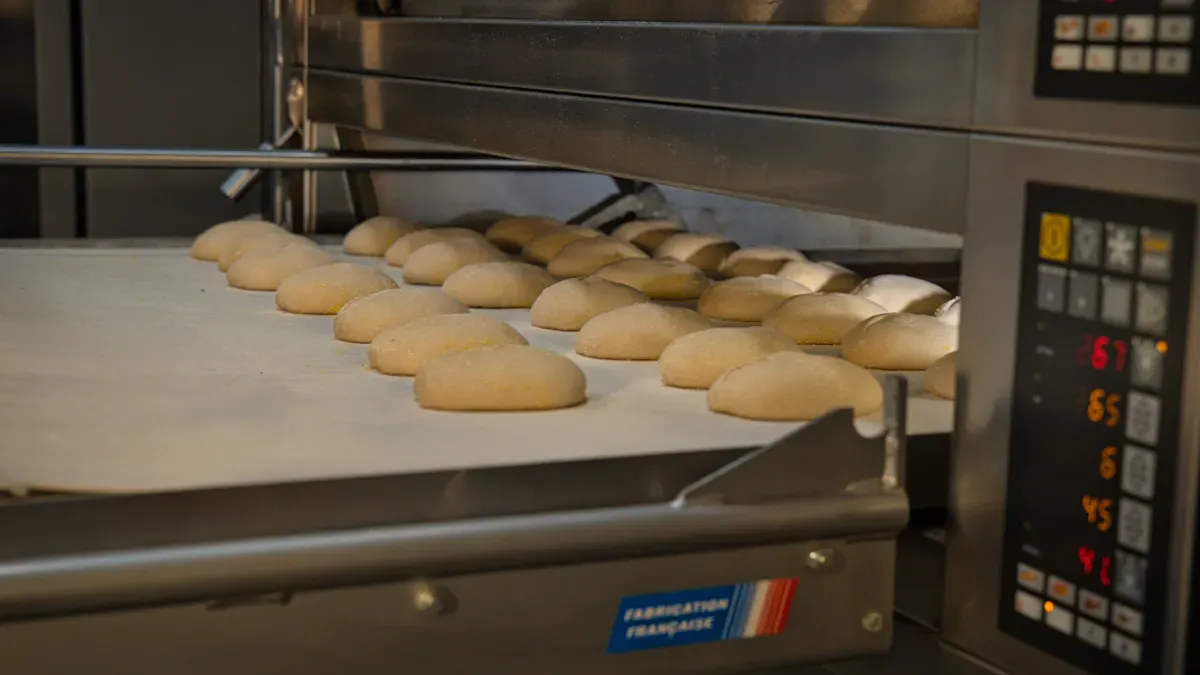
Tunnel Ovens with Multi-Zone Temperature Control
Tunnel ovens with multi-zone temperature control represent a major advancement in the cake baking production line. These ovens divide the baking chamber into several independently controlled zones. Operators can customize each zone to match the specific requirements of different cake types. Multiple heating zones allow precise control over the baking process, ensuring even and thorough baking. Cakes pass through each zone under consistent conditions, which guarantees uniform color, moisture, and texture. This technology enables bakeries to achieve consistent quality in every batch.
·Multiple independent temperature zones allow precise control over baking stages.
·Uniformity in color, moisture, and texture is ensured.
·Customizable heating zones adapt to various cake products.
Automated Cooling Conveyors
Automated cooling conveyors play a crucial role in maintaining cake quality after baking. These systems provide an efficient and controlled environment for rapid cooling. Effective temperature regulation prevents moisture loss and preserves the texture of baked goods. Cooling conveyors handle delicate cakes gently, maintaining their structural integrity. Consistent cooling across batches enhances product reliability and supports high-volume production. Operators benefit from reduced manual handling and improved hygiene.
Automated cooling conveyors ensure cakes retain their softness and appearance, supporting consistent results in every production cycle.
Integrated Sterilization Systems
Integrated sterilization systems contribute significantly to food safety in cake production. These systems use aseptic processing to eliminate harmful microorganisms, reducing the risk of foodborne illnesses. Sterilization extends the shelf life of cakes without the need for additives. Gentle processing methods preserve the taste and appearance of the final product. Bakeries that implement sterilization systems meet strict food safety standards and deliver high-quality cakes to consumers.
| Benefit | Description |
|---|---|
| Elimination of Microorganisms | Aseptic processing effectively eliminates harmful microorganisms, reducing the risk of foodborne illnesses. |
| Extended Shelf Life | The process increases the shelf life of products without the need for additives. |
| Quality Preservation | Maintains taste and appearance closer to original ingredients due to gentler processing methods. |
Energy-efficient baking, cooling, and sterilization equipment also help businesses reduce operational costs and environmental impact. Smart sensors optimize baking times and temperatures, minimizing energy waste. Companies using these systems can see a reduction in energy bills by up to 20% annually.
Decorating, Packaging, and End-of-Line Handling
Automated Decorating and Topping Machines
Automated decorating and topping machines transform cakes into visually appealing products while maintaining efficiency and consistency. These systems ensure portion accuracy, product uniformity, and cost control. They support a wide range of applications, including filling, layering, topping, and portioning for different cake varieties. Many industrial bakeries use advanced solutions like the ACIS, which can mid-fill, top and side ice, and finish up to 12 cakes per minute. This technology uses buttercream or whipped toppings to deliver perfectly finished cakes with speed and precision.
·Ensures portion accuracy and uniformity
·Supports multiple decorating and topping applications
·Delivers high-speed, consistent results
Operators benefit from reduced manual labor and improved product quality, which helps bakeries meet high production demands.
Slicing, Wrapping, and Sealing Equipment
Slicing, wrapping, and sealing equipment play a crucial role in packaging efficiency and product shelf life. Shrink wrap provides an airtight seal that minimizes air exposure, helping to slow spoilage and maintain freshness. It acts as a barrier against moisture and contaminants, which is essential for food safety. Uniform shrink wrap application also enhances product presentation, making cakes more attractive to consumers.
·Airtight seals slow spoilage and preserve freshness
·Moisture and contaminant barriers protect food safety
·Consistent packaging improves shelf appeal
Slicing, wrapping, and sealing machines, such as L Bar sealers, enable high-speed production and reduce labor costs. These machines wrap multiple products per minute with precision, ensuring consistent packaging quality for every cake.
Cartoning and Palletizing Solutions
Modern cartoning and palletizing solutions streamline the final stages of the cake baking production line. The latest systems, such as the tog. 519 cobot, automate the feeding of bakery products and operate at speeds up to 90 cycles per minute. AI-supported image processing ensures precise handling of various baked goods. Robotic top-loading systems simplify the cartoning process, while heavy-duty autoload cartoners increase speed and reduce manual labor. Flexible palletizing robots adapt to different product sizes and weights, improving packaging versatility.
Automated cartoning and palletizing solutions help bakeries reduce labor costs, increase efficiency, and maintain high standards for finished products.
Integration and Control Systems for Cake Baking Production Lines
Centralized Computer-Based Control Panels
Centralized computer-based control panels serve as the command center for modern cake baking production lines. These panels integrate multiple automation components, such as conveyor belts, ovens, and robotic arms, into a unified system. Advanced solutions like the Beckhoff IPC and TwinCAT software provide real-time process control through EtherCAT and Windows integration. Operators can manage synchronized drives and motors, ensuring precise control over conveyor movement, oven rotation, and door operations. The scalable design allows seamless integration of sensors and cameras, reducing engineering complexity. In practice, operators prepare dough and core rods, place them on the conveyor, and select the desired oven from the control panel. The system then coordinates robotic actions and AI-driven monitoring to guarantee consistent baking results.
Machine-to-Machine Communication and Data Monitoring
Machine-to-machine communication enables real-time data exchange between equipment, optimizing every stage of the cake baking production line. This connectivity offers several advantages:
1.Reduce changeover time by monitoring and improving average transition speeds.
2.Track downtime reasons with real-time displays, allowing operators to respond quickly.
3.Monitor speed and rate metrics for immediate adjustments if a lane stops.
4.Record historical production data to analyze and resolve process exceptions.
5.Send automated alerts for ingredient readiness, minimizing batch delays.
Continuous monitoring and adjustment of critical parameters, such as temperature and humidity, ensure optimal performance. Predictive maintenance algorithms help prevent unexpected downtime, while real-time data collection supports immediate process optimization.
User-Friendly Touch Screen Interfaces
User-friendly touch screen interfaces enhance operator efficiency and reduce training time. These intuitive HMIs (Human-Machine Interfaces) make system navigation accessible to both experienced professionals and new staff. Operators benefit from clear system visibility and straightforward controls, which minimize errors and speed up onboarding. The interface design supports quick recipe selection, parameter adjustments, and real-time monitoring. This accessibility ensures that bakeries can maintain high productivity with minimal training investment.
Tip: Touch screen interfaces not only improve workflow but also help maintain consistent product quality by reducing operator mistakes.
Integrated automation transforms the cake baking production line by delivering precise control over every stage, from mixing to packaging. Automated systems ensure consistent output and high product quality, as they manage timing, temperature, and speed with accuracy. Enhanced food safety results from hygienic equipment design and strict compliance with industry standards. Seamless system communication supports scalability and adaptability, allowing bakeries to expand without sacrificing efficiency or quality.
·Seamless communication prevents bottlenecks and synchronizes production stages.
·A unified ecosystem enables consistent, scalable operations.
FAQ
What types of cakes can an automated production line handle?
Automated cake production lines, such as the L-XINJINGYAO, can produce a wide range of cakes. Operators can switch between stuffed egg yolk pastries, paper cup cakes, and sliced cakes by changing molds.
How does automation improve food safety in cake production?
Automation reduces manual contact with ingredients and finished products. This minimizes contamination risks and ensures compliance with strict hygiene standards.
Can operators adjust recipes easily on automated lines?
Operators use touch screen interfaces to store and select recipes. The system allows quick adjustments to parameters, supporting flexible production and consistent results.
What maintenance does an automated cake production line require?
Routine cleaning and inspection keep the equipment running smoothly. Food-grade stainless steel construction simplifies maintenance and ensures long-term durability.
Post time: May-23-2026


